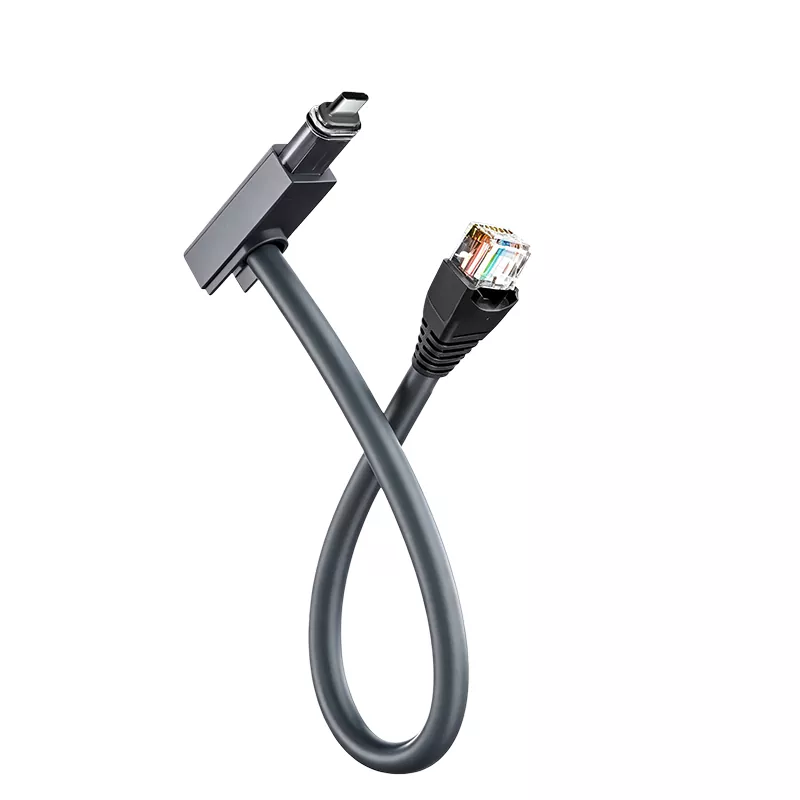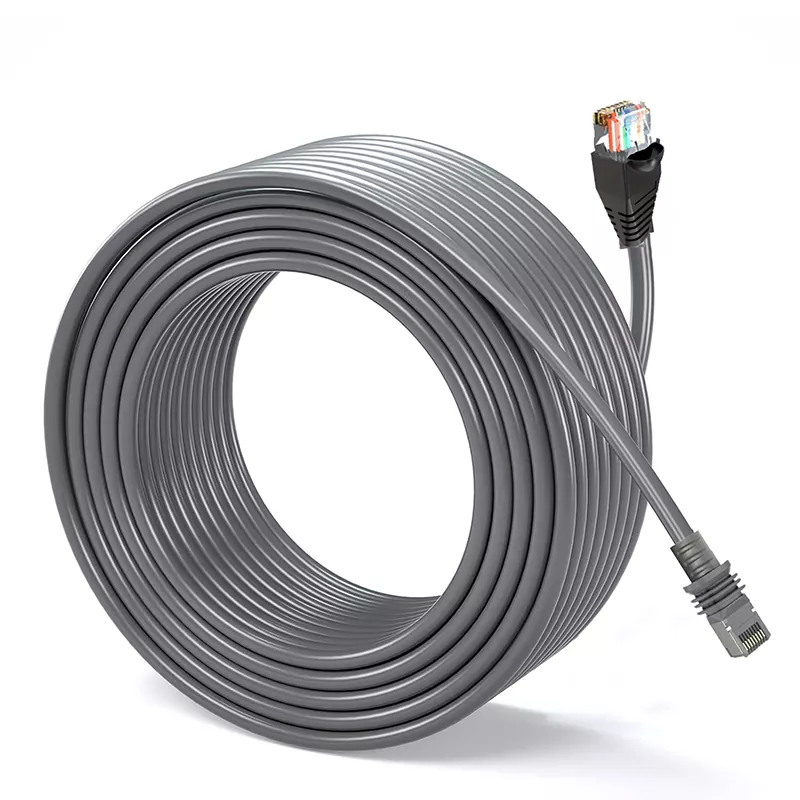
CAT6 Cable (Category 6) is a twisted-pair Ethernet cable designed for high-speed data transmission in local area networks (LANs). It consists of four twisted pairs of copper conductors and operates at a maximum bandwidth of 250 MHz, supporting 1 Gbps over the full 100-meter channel and 10 Gbps (10GBASE-T) over distances up to 55 meters. Compared to its predecessor Cat5e, CAT6 introduces tighter twist specifications, a thicker conductor gauge (typically 23 AWG), and often an internal spline separator to reduce crosstalk between pairs. The cable is widely deployed in commercial office networks, PoE-powered device installations, and short-run 10-Gigabit backbone connections.
CAT6 cables are available in several shielding configurations, defined by the ISO/IEC 11801 naming convention "overall shield / pair shield." U stands for unshielded, F for foil, and S for braid.
U/UTP (Unshielded Twisted Pair): No overall shield and no pair-level shield. The most common and cost-effective CAT6 construction, suitable for clean electromagnetic environments such as homes and standard offices.
F/UTP (Foiled Unshielded Twisted Pair, often called FTP): An overall aluminum foil shield surrounds the four unshielded twisted pairs. Provides moderate protection against EMI/RFI and is a common choice for commercial installations.
S/FTP (Screened Foiled Twisted Pair): Each individual pair is wrapped in foil, and an overall copper braid shield encloses the cable. This is the highest-shielding CAT6 construction, recommended for electrically noisy environments such as production halls with motors and variable-frequency drives.
AWG (American Wire Gauge): Indicates the thickness of the copper conductors. CAT6 cables most commonly use 23 AWG or 24 AWG. A lower AWG number means a thicker conductor, which lowers DC resistance and improves signal integrity. 23 AWG is the preferred gauge for PoE deployments and for installations where lower heat buildup and more stable power delivery are required. Conductor material is typically solid bare copper for horizontal cabling and stranded bare copper for patch cords; CCA (Copper-Clad Aluminum) is also available at lower cost but offers inferior conductivity and is not recommended for PoE or long-term reliability.
Commercial office LANs — Gigabit-to-the-desk connectivity and backbone links under 55 meters for 10G
PoE and PoE+ devices — Security cameras, VoIP telephones, wireless access points, access control devices, and point-of-sale kiosks
High-density data centers — Switch-to-server and switch-to-router connections
Short-run 10-Gigabit links — Server-to-switch connections within 55 meters
CCTV / IP surveillance systems — Power and data delivery over a single cable to remote cameras
CAT6 cables are commonly available in:
Blue — The most widely used color for general Ethernet patching
Gray — Standard for commercial and structured cabling installs
White — Popular for clean, visible indoor routing
Black — Common for outdoor and industrial applications
Yellow, Red, Green, Orange, Purple — Used for color-coding network segments or VLANs
Custom colors — Available upon request for OEM/ODM orders, including PMS color matching
Double the Bandwidth of Cat5e: CAT6 operates at 250 MHz versus Cat5e's 100 MHz, providing a wider frequency window for high-speed data and reducing the likelihood of the cable becoming a bottleneck as network demands grow.
Improved Crosstalk Performance: CAT6 specifies stricter crosstalk and noise margins than Cat5e. Many CAT6 designs incorporate an internal spline separator that physically isolates the four pairs, significantly reducing alien crosstalk in bundled installations.
Thicker Conductor Gauge (23 AWG): The larger copper conductors in CAT6 lower DC resistance compared to 24 AWG Cat5e, improving power delivery efficiency for PoE applications and reducing heat generation in high-power PoE++ deployments.
10GBASE-T Capability: While Cat5e is limited to 1 Gbps, CAT6 supports 10 Gbps over runs up to 55 meters, enabling short-run 10-Gigabit connectivity without upgrading to Cat6a or fiber.
Backward Compatibility: CAT6 is fully backward compatible with Cat5e and earlier Ethernet standards, using standard RJ45 connectors and the same 100-ohm impedance, allowing drop-in replacement in existing network infrastructure.
CAT6 cables are manufactured to comply with the following standards:
|
Standard |
Description |
|
ANSI/TIA-568.2-D (Category 6) |
North American performance standard for balanced twisted-pair cabling |
|
ISO/IEC 11801 (Class E) |
International structured cabling standard for CAT6 / Class E channels |
|
CENELEC EN 50173-1 |
European generic cabling standard |
|
UL Certified |
Underwriters Laboratories safety compliance |
|
ETL Listed |
Intertek electrical testing laboratory verification |
|
CM / CMR / CMP Rated |
NEC jacket ratings for general-purpose, riser, and plenum installations respectively |
|
LSZH (optional) |
Low Smoke Zero Halogen jacket available for fire-sensitive environments |
|
RoHS Compliant |
Restriction of Hazardous Substances compliance |
|
REACH Compliant |
European chemical safety regulation compliance |
|
CE Certified |
European conformity for safety and environmental requirements |
|
IEEE 802.3af / at / bt |
Compliance with PoE, PoE+, and PoE++ power delivery standards |
Reputable CAT6 cable suppliers can typically provide:
Fluke / Link Test Reports — Channel or permanent link certification to TIA or ISO limits
UL / ETL Certification — Safety and electrical compliance
CE Certification — European market conformity
RoHS & REACH Compliance — Environmental and chemical safety documentation
ISO 9001 — Quality management system certification
Flame Retardant Certificates — CM, CMR, CMP, or LSZH test reports
Material Test Reports — Conductor gauge verification, shielding effectiveness, and jacket mechanical properties
|
Parameter |
Specification |
|
Pair Count |
4 twisted pairs (8 conductors) |
|
Conductor Material |
Solid bare copper (horizontal) / stranded bare copper (patch cord); CCA optional |
|
Conductor Gauge |
23 AWG or 24 AWG |
|
Characteristic Impedance |
100 Ω ± 15 Ω |
|
Max Bandwidth |
250 MHz |
|
Data Rate / Distance |
1 Gbps up to 100 m; 10 Gbps up to 55 m |
|
Shielding Options |
U/UTP, F/UTP, S/FTP |
|
Jacket Material |
PVC (standard), LSZH (optional) |
|
Jacket Ratings |
CM, CMR, CMP, or LSZH |
|
Separator / Spline |
Cross-shaped spline common in UTP designs to reduce crosstalk |
|
Temperature Range |
Typically –20°C to 75°C (varies by jacket compound) |
|
PoE Support |
IEEE 802.3af (PoE), 802.3at (PoE+), and 802.3bt (PoE++) |
|
Outer Diameter |
Typically 5.5 mm – 6.5 mm depending on shielding and jacket |
PE Bag + Carton — Standard bulk packaging for patch cords and short lengths
Reel / Pull Box — 305 m (1000 ft) or 500 m wood or plastic reel for horizontal cabling
Blister Pack / Clamshell — Retail-ready packaging for consumer patch cords
Gift Box — Premium packaging for branded retail products
Custom Packaging — OEM/ODM branding, headcards, zip-lock bags, and printed cartons available upon request
Packaging for bulk cable typically includes a rip cord and sequential meter marking on the jacket for accurate length tracking during installation.
To request a quote for CAT6 Cable, please provide the following information and contact sales06@tldcable.com:
Category (CAT6 UTP / F/UTP / S/FTP)
Conductor gauge (23 AWG / 24 AWG)
Conductor material (solid bare copper / stranded bare copper / CCA)
Shielding type (U/UTP, F/UTP, or S/FTP)
Jacket material (PVC / LSZH)
Jacket rating (CM / CMR / CMP)
Color preference
Order quantity (meters or reels for bulk cable; pieces for patch cords)
Sample order or bulk order?
Custom length (patch cords or reel lengths)
Custom color (including PMS matching)
Custom connector plating (gold / nickel) for patch cords
Custom packaging and branding (OEM/ODM)
Any specific certifications needed (UL, ETL, CE, RoHS, REACH, Fluke test)?
Any specific testing or inspection requirements?
Destination country/port
Preferred shipping method (air, sea, express)
Required delivery timeline
Fiber Optic Cable
USB Cables
HDMI Cables
DP Cables
Patch Cord Cable
Starlink Cable