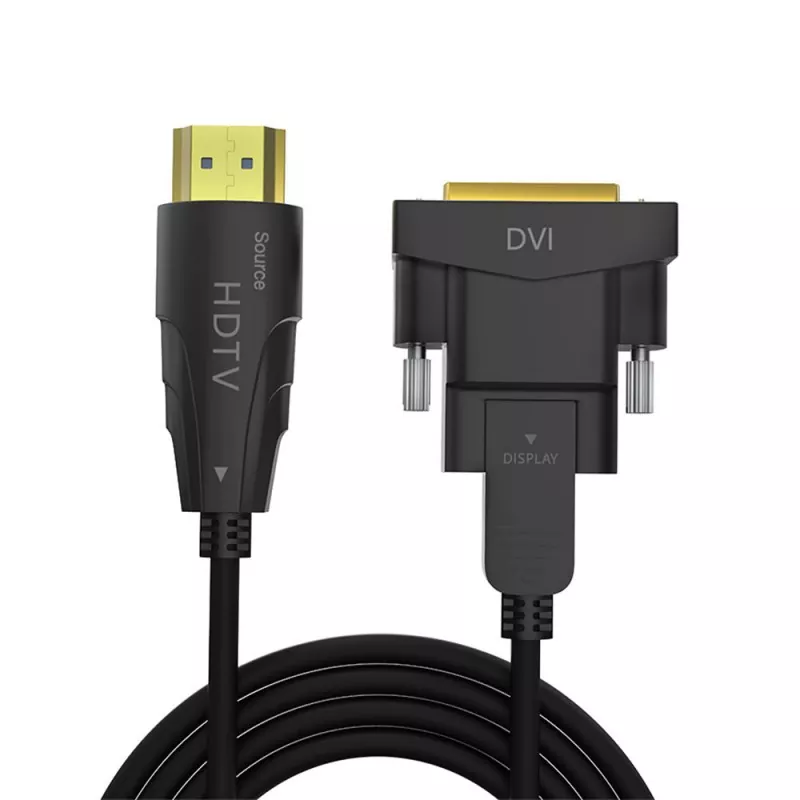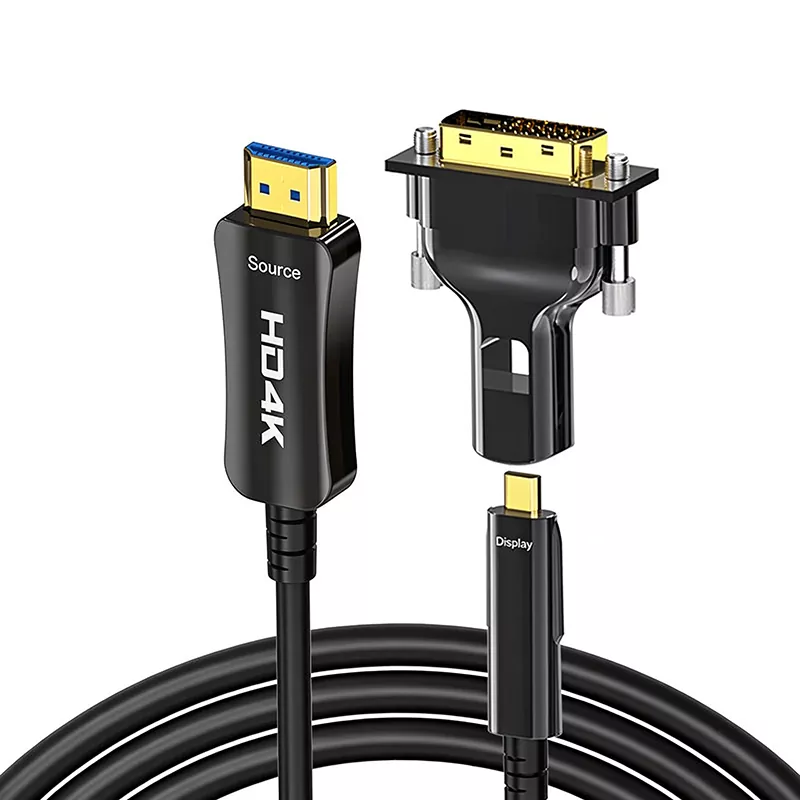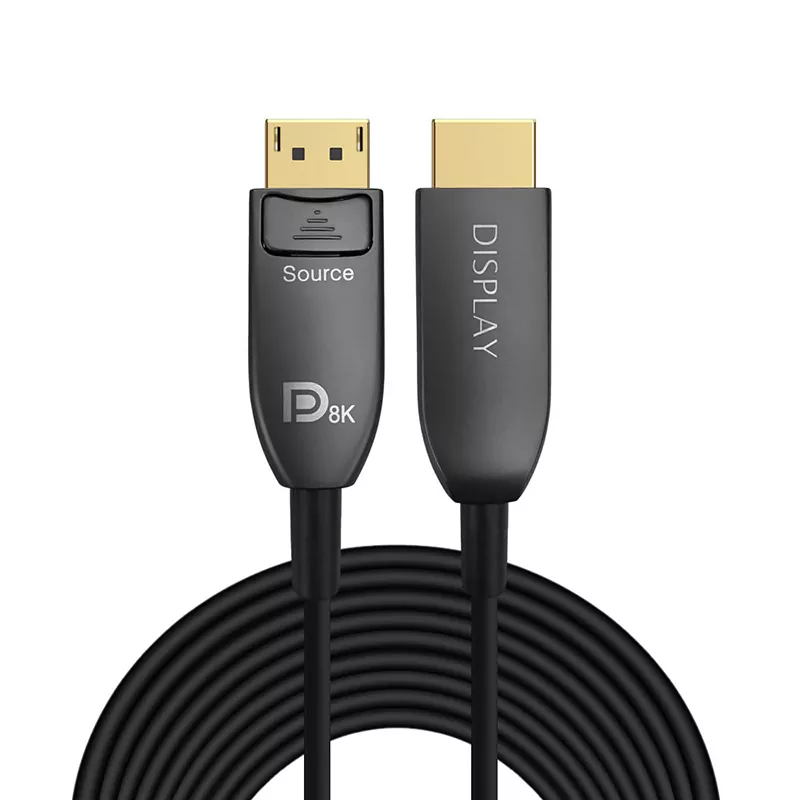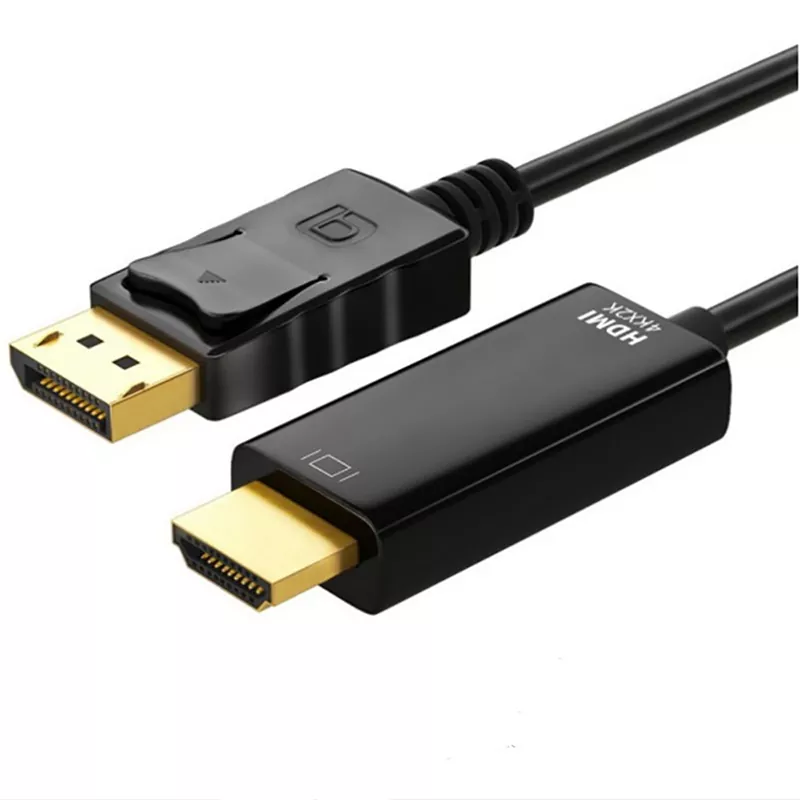
What’s Fiber Optic HDMI Cables?
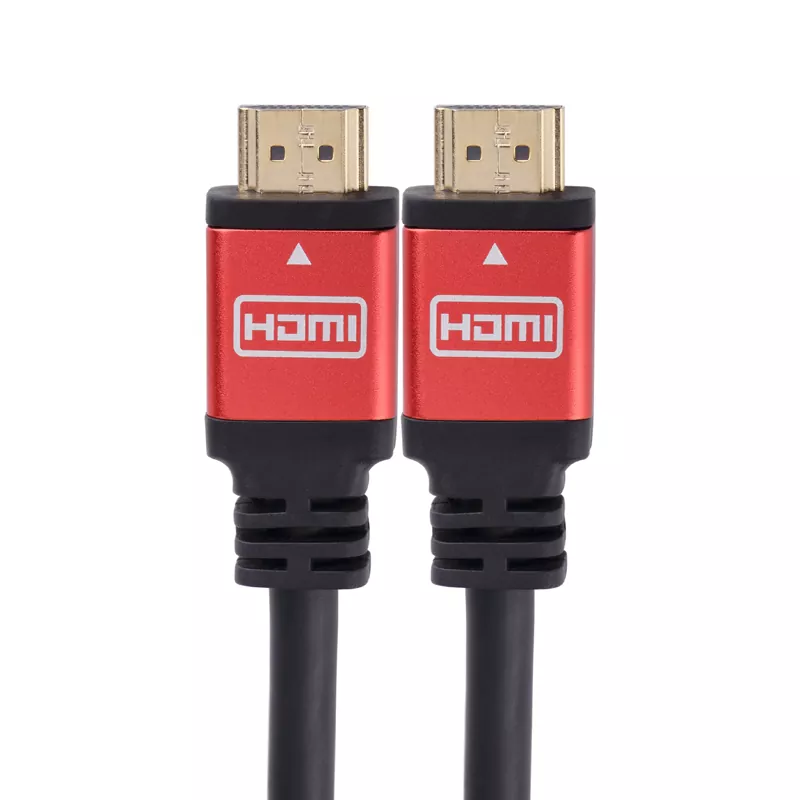
Fiber Optic HDMI Cables, also commonly called HDMI AOC (Active Optical Cable), is a digital audio/video interface cable that uses optical fiber for high-speed HDMI signal transmission. It is designed to transmit uncompressed high-definition video and multi-channel audio between HDMI-enabled devices over longer distances than conventional copper HDMI cables.
Most fiber optic HDMI cables use a hybrid construction: optical fibers carry the high-bandwidth TMDS video/audio lanes, while copper conductors handle low-speed signals and power, such as DDC, CEC, HPD, +5V, and optional ARC/eARC. This design supports stable 4K/60Hz, HDR, and—depending on the HDMI version—8K/60Hz or 4K/120Hz transmission over distances typically from 5m to 100m. Fiber optic HDMI cables are widely used in home theaters, conference rooms, digital signage, gaming setups, and professional AV installations.
Hybrid Fiber Optic HDMI (HDMI AOC): The most common type. High-speed video/audio signals travel over optical fiber, while copper conductors provide power and low-speed control signals. Typically bus-powered and suitable for long-distance 4K/8K transmission.
Pure Fiber Optic HDMI: Uses optical fiber for signal transmission with a separate power or powered connector design. It is used in ultra-long or EMI-sensitive installations, but is less common and usually requires confirmation of power and compatibility requirements.
HDMI 2.1 Fiber Optic HDMI: Designed for 48Gbps bandwidth, supporting 8K/60Hz, 4K/120Hz, Dynamic HDR, and eARC. It is intended for next-generation gaming consoles, high-end AV receivers, and premium home theater systems.
AWG (American Wire Gauge): In fiber optic HDMI cables, AWG mainly refers to the copper conductors used for power and low-speed control signals, not the optical fiber lanes. Common gauges range from 24 AWG to 28 AWG. Lower AWG numbers mean thicker copper conductors, which can provide better power delivery and durability.
Shielding: Although optical fibers are immune to electromagnetic interference, the copper conductors and connector assemblies still require proper shielding. Fiber optic HDMI cables typically use foil/Mylar and braided shielding around copper components and shielded connector shells to maintain signal integrity and reduce EMI/RFI in demanding installations.
Home theater systems (TV to receiver/projector)
Long-distance projector and display connections
Gaming consoles (PS5, Xbox Series X/S) to displays
PC/laptop to external monitors or conference displays
Commercial digital signage and presentation systems
Conference rooms, classrooms, and control rooms
EMI-sensitive environments such as medical, industrial, and broadcast AV setups
Ultra-long HDMI runs where copper cables would require signal boosters
Fiber Optic HDMI cables are commonly available in:
Black — Most standard and widely available
White — Popular for indoor/home installations
Gray — Common for commercial and custom installs
Custom colors — Available upon request for OEM/ODM orders, such as red, blue, yellow, and green
Long-Distance Transmission: Supports stable 4K/8K signals over much longer runs than passive copper HDMI cables, reducing the need for repeaters or boosters.
Low EMI/RFI: Optical fiber is immune to electromagnetic interference, making AOC ideal for complex AV environments and installations near power lines.
Lightweight and Flexible: Fiber optic HDMI cables are generally thinner and lighter than long copper cables, simplifying cable routing and installation.
Stable High-Bandwidth Performance: Supports HDMI 2.0 18Gbps and HDMI 2.1 48Gbps configurations for high-resolution video, HDR, and high frame rates.
Directional Design: Most AOC cables are directional, with clearly marked source and display connectors, ensuring reliable active optical transmission.
Reduced Signal Degradation: Maintains signal quality over long distances without the heavy attenuation typical of passive copper cables.
Cleaner Installation: Smaller diameter and lighter weight make fiber optic HDMI cables easier to manage in walls, cable trays, and conduit.
Direct Connection: Connect the source-end connector to the HDMI output of the source device, such as a laptop, game console, media player, or receiver. Connect the display-end connector to the HDMI input of the TV, monitor, or projector. Observe the direction arrows or “Source”/“Display” labels on the connectors.
HDMI to DVI-D Adapter: Connects HDMI sources to DVI-D displays; video only, no audio. Compatibility with active AOC should be confirmed.
HDMI to VGA Adapter: Converts digital HDMI to analog VGA for older monitors/projectors; active conversion and external power may be required.
HDMI Female-to-Female Coupler: Joins two HDMI cables to extend length. Not all AOC cables support passive couplers; confirm before use.
HDMI Wall Plates: For permanent in-wall installations with clean faceplate connections.
HDMI Repeater/Extender: For specialized long-distance systems beyond standard AOC length ratings.
HDMI to DisplayPort Adapter: For connecting HDMI sources to DisplayPort monitors, subject to adapter and AOC compatibility.
Use fiber optic HDMI AOC cables for long-distance runs where passive copper cables are not reliable. Avoid sharp bends, tight coils, and excessive pulling force during installation. For distances beyond the rated AOC length, use compatible HDMI optical extenders or consult the supplier for a custom solution.
HDMI cable suppliers can typically provide the following accessories:
Fiber Optic HDMI cables in various lengths, such as 5m, 10m, 15m, 20m, 30m, 50m, and 100m
HDMI 2.0 and HDMI 2.1 fiber optic HDMI cables
Custom length cables with OEM/ODM services
Directional AOC cables with source/display labels
Slim and lightweight fiber optic HDMI cables
In-wall rated and LSZH jacket options
Armored or reinforced jacket options for commercial installations
HDMI to DVI-D adapters
HDMI to VGA adapters
HDMI female-to-female couplers
HDMI male-to-male extension adapters
HDMI to DisplayPort adapters
HDMI wall plates and faceplates
Cable management clips and ties
HDMI signal repeaters / boosters
Fiber optic HDMI extenders
Protective caps for unused connectors
Direction labels and installation guides
Fiber Optic HDMI cables can be manufactured to comply with the following standards:
|
Standard |
Description |
|
HDMI 2.0 / HDMI 2.1 Specification |
Compliant with HDMI Licensing Administrator requirements for the applicable HDMI version |
|
UL Certified |
Underwriters Laboratories safety standard |
|
CMG / CMX Rated |
General-purpose and outdoor-rated cable jackets |
|
CMR Rated |
Riser-rated for in-wall installation and fire safety |
|
CMP Rated |
Plenum-rated for air-handling spaces |
|
CL2 / CL3 Rated |
In-wall and class-rated installation options |
|
RoHS Compliant |
Restriction of Hazardous Substances compliance |
|
REACH Compliant |
Registration, Evaluation, Authorization, and Restriction of Chemicals |
|
CE Certified |
European conformity for safety and environmental standards |
|
FCC Certified |
U.S. Federal Communications Commission compliance for EMI |
Reputable fiber optic HDMI cable suppliers can typically provide:
HDMI ATC Certification — Authorized Testing Center validation for HDMI compliance
UL Certification — Safety compliance
CE Certification — European market conformity
RoHS & REACH Compliance — Environmental and chemical safety
ISO 9001 — Quality management system
Flame Retardant Certificates — CMP, CMR, CL2/CL3, and CPR ratings
EMI/EMC Test Reports — Electromagnetic compatibility
Optical Performance Test Reports — Insertion loss, signal integrity, and eye diagram testing
Material Test Reports — Conductor gauge, shielding effectiveness, jacket properties, and mechanical performance
|
Parameter |
Specification |
|
Connector Type |
Standard Type-A HDMI male to male; directional source/display connectors; other configurations available by customization |
|
Transmission Construction |
Hybrid fiber and copper; optical fiber for high-speed TMDS lanes, copper for power and low-speed control signals |
|
Fiber Type |
Multi-mode optical fiber for high-speed HDMI signal transmission |
|
Copper Conductors |
24 AWG to 28 AWG for power, DDC, CEC, HPD, and optional ARC/eARC |
|
Shielding |
Foil/Mylar and braided shielding around copper components; shielded connector shell |
|
Jacket Material |
PVC, TPE, LSZH, or nylon braided for durability and flexibility |
|
Temperature Range |
Typically -20°C to 70°C (-4°F to 158°F); options available for extended requirements |
|
Bandwidth |
Up to 18 Gbps for HDMI 2.0; up to 48 Gbps for HDMI 2.1 |
|
Supported Resolutions |
4K×2K at 60Hz, 1080p, 3D; 8K/60Hz and 4K/120Hz for HDMI 2.1 versions |
|
HDR Support |
HDR10, Dolby Vision, and Dynamic HDR depending on HDMI version |
|
Audio Support |
Up to 8 channels of 24-bit/192kHz uncompressed audio; ARC/eARC depending on model |
|
ARC/eARC Support |
Available on selected models |
|
HEC Support |
Available on selected models |
|
Deep Color Support |
Yes, up to 48-bit per pixel depending on version |
|
Connector Plating |
Gold-plated contacts for corrosion resistance |
|
Outer Diameter |
Typically 4.0mm to 6.5mm depending on jacket and construction |
|
Length Range |
Typically 5m to 100m; custom lengths available |
|
Directionality |
Yes, most AOC cables are directional; source and display ends must be observed |
Fiber optic HDMI cables are typically packaged using the following methods:
PE Bag + Box — Standard retail packaging with individual boxes
Blister Pack / Clamshell — Common for consumer retail displays
OP Bag — Simple poly bag for bulk orders without retail branding
Gift Box — Premium packaging for high-end products
Carton Box — Bulk packaging for wholesale/distribution orders
Custom Packaging — Available upon request with OEM/ODM branding
Packaging often includes protective caps on both cable ends to prevent dust ingress and connector damage during shipping. Direction labels and installation notes are recommended for AOC cables.
To request a quote for Fiber Optic HDMI Cable, please provide the following information and contact sales06@tldcable.com:
Required length, such as 5m, 10m, 15m, 20m, 30m, 50m, or 100m
HDMI version: HDMI 2.0 or HDMI 2.1
Connector type: Type-A to Type-A, or other configurations
Cable construction: hybrid fiber optic AOC or other required design
Jacket material: PVC, TPE, LSZH, or nylon braided
Color preference
In-wall rating requirement, such as CL2/CL3, CMR, or CMP
Order quantity
Sample order or bulk order
Custom length needed?
Custom color?
Custom connector plating, such as gold or nickel?
Custom packaging and branding for OEM/ODM?
Directional labeling and installation accessories?
Any specific certifications needed, such as HDMI ATC, UL, CE, RoHS, or REACH?
Any specific testing or inspection requirements?
Optical performance test report required?
Destination country/port
Preferred shipping method: air, sea, or express
Required delivery timeline
HDMI Cables
USB Cables
DP Cables
Starlink Cable
USB C Cables
Computer Monitor Cable
Patch Cord Cable
Fiber Optic Cable